



You’ve chosen your new city, neighborhood, and apartment. All of the hardest choices are out of the way—but there’s still plenty of labor-intensive work to come. Moving into an apartment presents a unique set of challenges, but this moving guide and checklist will help you cope by offering moving tips and tricks to keep you organized.
Printable Checklist for Apartment Renters
Why you can trust Move.org
movers helped every month
20k
moving grants awarded
24
moving companies evaluated
156
years of expert experience
80+
For over 8 years, Move.org experts have examined pricing, credentials, and real customer reviews to give you (human) recommendations you can trust. See how we review.

 8 min read
Catrina Cowart has been writing full-time since 2009. Since starting as a writer and editor, she has worked with small business owners, retailers and others to produce marketable, SEO-ready content to boost their businesses.
At a glance


Moving checklist for apartment renters

Of course, not all measurements can be nicely divided by 12. For example, if your dining table is 63 inches long, you won’t be able to write down its dimensions using only feet.
For situations like this, find the closest number divisible by 12 to the object’s length, calculate how many feet that is and write it down, and then write down how many inches are left over. The length of the table from our example would be written as “5 feet 3 inches” or “5′3″.”
When to measure in linear feet
Use linear feet to measure anything in a straight line. If you need to know the length of a rug, the width of a bookcase, or the height of your child, linear feet will do the trick.
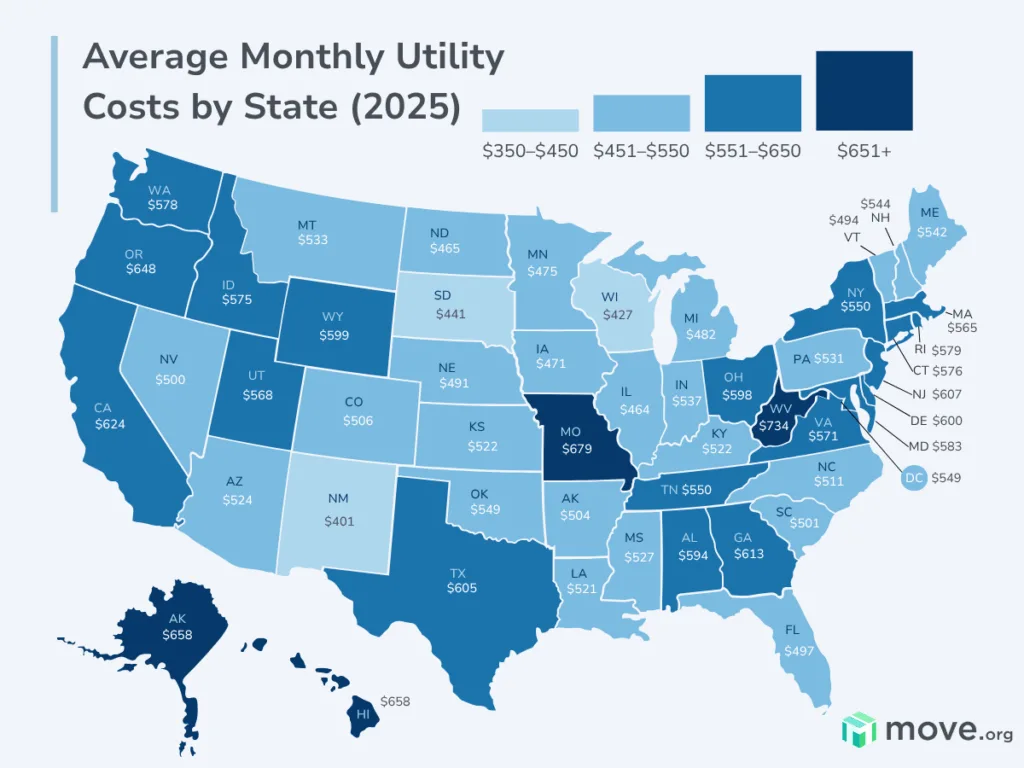
Average monthly utility costs by state: Which states pay the most?
Now that we’ve discussed the national averages for utility expenses, let’s talk about how much utilities cost per month in different states.
Utility cost trends in 2025
- Electricity tops the list as the most expensive part of a typical monthly utility bill, while water typically remains the least costly (depending on where you live).
- Compared to last year, average costs for electricity, natural gas, water, sewer, and streaming services have all gone up, while average trash, internet, and phone expenses have remained the same.
- 7 states have average utility bills higher than the national average: West Virginia ($734), Missouri ($679), Alaska ($658), Hawaii ($658), Oregon ($648), California ($624), and Georgia ($613).
- In 6 states, utility costs exceed 10% of the state’s median monthly income: West Virginia (13.95%), Mississippi (11.29%), Alabama (10.87%), Missouri (10.4%), Louisiana (10.29%), and Oklahoma (10.09%).
- 13 states spend a larger percentage of monthly income on utilities than the national average: West Virginia, Mississippi, Alabama, Missouri, Louisiana, Oklahoma, Kentucky, Arkansas, Wyoming, North Carolina, Georgia, Ohio, and Texas.
- On average, the monthly cost of utilities increased by $28 compared to last year.
- New Jersey and Alaska saw the biggest increase in monthly utility costs. Residents in each state pay an average of $102 more per month compared to the previous year.
- 3 states saw a year-over-year decrease in monthly utility expenses: Hawaii (↓$98), Florida (↓$24), and Arizona (↓$3).
The top 5 states with the most expensive utilities (based on % of income)
Rankings are based on total cost and percent of income spent on utilities.
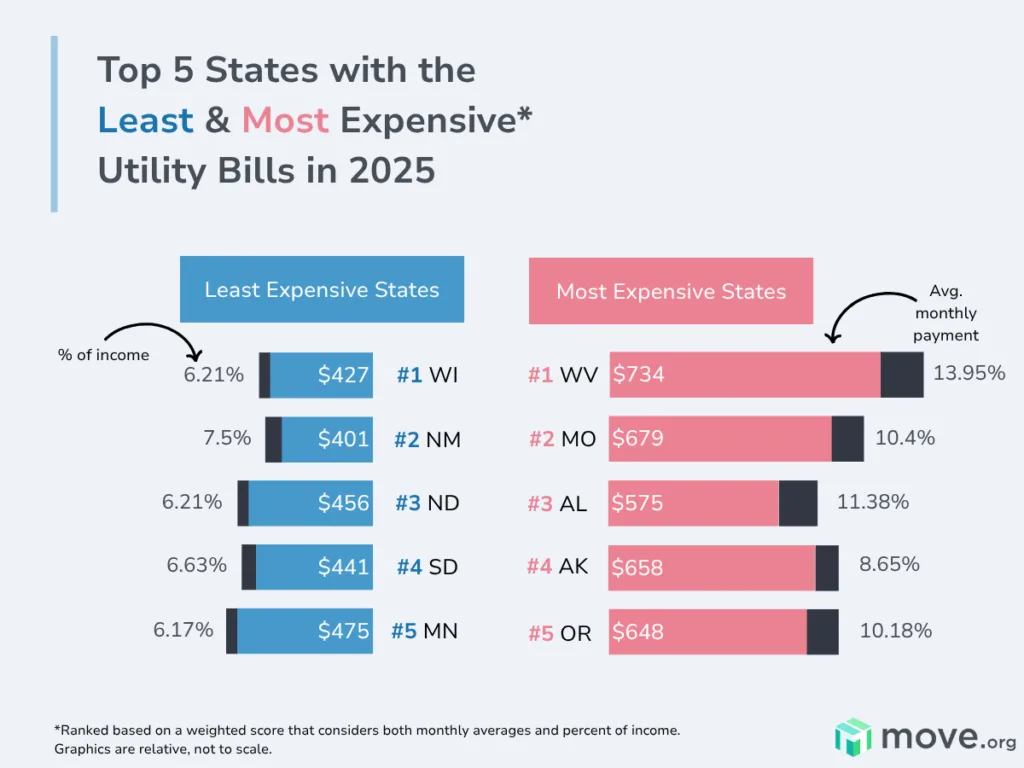
1. West Virginia: $734/mo. | 13.95% of income
We’re sorry, West Virginia, but you’ve earned the top spot for utility costs as a percentage of income and for the highest average cost of utilities overall. Residents of The Mountain State also face the highest average water bill in the country at $121 per month—far above the national average of $49 per month for a typical water bill. This rise is partly due to the increased Distribution System Improvement Charge (DSIC), which goes toward infrastructure upgrades and improved water quality. Overall, West Virginians pay about $42 more per month for utilities compared to last year.
2. Missouri: $679/mo. | 10.4% of income
Missouri jumped to the second spot this year after ranking fourth last year. Residents of The Show-Me State pay the second-highest utility bills in the nation, and they saw a $73 average increase in their monthly utility bills compared to last year. Missourians pay the third-highest sewer bills and fourth-highest natural gas bills in the nation.
3. Alabama: $575/mo. | 11.38% of income
Alabama’s hot summers mean some of the highest electricity bills in the US, with seven out of 10 residents relying on electric power to cool their homes. Electricity costs the average Alabaman $184 per month and makes up more than 30% of the total utility bill. The increased cost of electricity was balanced out by a decrease in natural gas costs, resulting in an average year-over-year utility bill increase of about $19 in The Yellowhammer State.
4. Alaska: $658/mo. | 8.65% of income
Alaska ranked 21st on last year's list but rocketed up to fourth place for 2025. A surge in natural gas prices seems to be behind the $102 average increase in Alaskans' monthly utility bills. Residents of The Last Frontier pay the third-highest utility bills nationwide. Electricity, water, sewer, and internet services also cost above-average in this state.
5. Oregon: $648/mo. |10.18% of income
Climbing from eighth to fifth in our rankings, Oregon has seen the cost of electricity, natural gas, water, and sewer services rise over the last year. Residents of The Beaver State still pay below average for electricity and natural gas, but their typical water and sewer bills cost more than double the national averages. As is the case in West Virginia and other states, these rising costs tend to cover infrastructure repairs.
Apartment moving timeline
Two months before move
- Create a moving binder. Use it to keep track of everything move-related—your printable checklist, documentation, receipts, contact info, moving estimates, final bills, and other info you get from moving companies.
- Create a budget. Moving can be expensive, and hidden costs can easily cause you to spend a lot more than anticipated. Be prepared by researching costs and reading our guide on the cheapest way to move.
- Start packing your first (small) box. This box will not be packed or shipped with the others, but it will stay with you throughout the move. It will contain your important documents, like your passport, will, deed, etc. Begin gathering these documents early so you can identify any missing items. This box could also contain small valuables.
- Back up your files. Before you pack your computer and its peripherals, make a backup of important files and family photos on a disk or flash drive that you can carry with you (maybe in your box of essentials) during the move.
- Research and gather quotes from moving companies. It’s important to spend some time researching moving companies and their prices. If you’re looking to save money on your move you can also check out our guides to the cheapest truck rental companies and cheapest moving container companies.
- Decide what to sell or donate. Sell items online or through a garage sale. There are also plenty of community organizations that would be happy to take your donations off your hands.
- Create a room-by-room inventory of items throughout your home. An inventory allows you to organize everything you own and depict the value of each item. It helps you get more accurate moving quotes, determine renters insurance, speeds up potential claims, and more.
One month before move
- Decide on a moving company. Get a written contract that includes your moving date and costs. Or, if you’re renting a truck, make your reservation.
- Buy packing supplies. Packing costs can quickly add up. Check out our moving boxes guide to find boxes that are durable but affordable. You’ll also need tape, packing paper, and bubble wrap for packing fragile items. Cover your bases with our list of packing essentials.
- Clear your freezer. Your freezer should be clear about a week before the apartment move. Take this time to dig into the back of your pantry, as well. Use it or get rid of it. Here are some tips on packing food and liquids to prevent spills.
- Plan your new home. Get the dimensions at the new apartment and start planning how to arrange your furniture.
- Care for your car. It’s always a good idea to take your car to a trusted mechanic and ask what services might be needed for a long-distance drive or a move to a new climate. Contact your car insurance company to update the address on your policy. If needed, explore options to find the cheapest way to ship your car.
- Contact your internet, TV, and utilities providers. Set your utilities’ disconnect date. Begin researching which providers you’ll use at your destination and schedule connection of your services.
- Fill any prescriptions. Ask for doctor/pharmacist recommendations in your new area and consider obtaining copies of your medical records.
- Make travel arrangements. If necessary, book your flight, hotel, rental car, etc. If you’re driving long-distance, plan your route and stops.
Two weeks before move
- Change your address. Head to the United States Postal Service’s website to have your mail forwarded from the old place to the new. Also, update your new address with your bank.
- Cancel or redirect scheduled deliveries and subscriptions. This includes any routine package deliveries, meal services, etc.
- See if you need a moving permit. Some cities or areas require moving permits for moving trucks.
- Confirm dates with relevant parties:
- Landlord(s) for move-in/move-out
- Moving company or moving truck rental
- Self-storage company
- Other people to notify of your move
- Begin packing. Pack one room per day, as often as possible. Move any leftover items (excluding furniture) to a centralized location. Schedule enough time to have the packing done at least two days before your moving date.
One week before move
- Begin cleaning empty rooms. Make sure to do a thorough clean. How well you clean can mean the difference between all, some, or none of your deposit being returned to you. Pay attention to any instructions your landlord or rental office has given you.
- Pack suitcases. Have one for everyone in the family to live out of for a few days as you complete packing everything in the apartment.
- Collect all keys. They will need to be handed over to the landlord.
Moving day
- Have specific information for your movers. If you’ve hired moving services, provide the professional movers with your contact information, the address of the new place, and maps for getting to your new location.
- Make sure the right truck shows up. It should have a USDOT number printed on the side that matches the number on the contract you signed.
- Sign the movers’ bill of lading/inventory list. Be sure to keep a copy for yourself.
- Tip your movers! Our recommendation for tipping your movers is $20 per person for half-day moves or $40 per person for full-day moves.
After you've arrived
- Check your utilities. Make sure everything is working properly.
- Take plenty of pictures. If there is damage anywhere, these pictures will come in handy. This is vital if you’re a renter.
- Change the locks. Be sure to ask your landlord’s permission. If you get it, give them a copy of the key.
- Plan your housewarming party. If you have family or friends in the area, invite them. Or invite and get to know some your neighbors.
- Update your license and registration. Go to the DMV and make sure you have everything you need for your vehicle.
The takeaway
Whether you’re moving from to an apartment in a big city like New York or to one in small town, this ultimate moving checklist will help you navigate the unique challenges of moving from one apartment complex to another.
Would you like to learn more about moving to a new apartment? Check out Move.org for our guide to the best apartment movers and our best moving companies of the year.
Apartment renters moving checklist FAQ
If you’re moving to a new apartment, it’s essential to get packing supplies and moving boxes, sort through your belongings, move your utilities to the new address, and make travel arrangements. You’ll also need to change your address, redirect subscriptions, get moving insurance, and apply for renters insurance for your new apartment. If you’re hiring movers, take time to compare pricing options and book your moving date well in advance.
Start by packing up your most important documents (like passports and birth certificates) and valuables. Then move onto seasonal decor and clothing. Finally, pack up the rest of your house by moving room to room. Don’t forget to pack a suitcase with a few days’ worth of clothes and toiletries. Leave toilet paper and cleaning supplies out of boxes until the last minute.
Create a moving binder with documents and apartment checklists four months before you move. You can also gather documents and valuables that you want to keep safe during the moving process. Next, back up your files, research moving companies, and decide what you want to sell or donate. Take inventory of your home so you’re ready to pack when it gets close to your moving date.
Simplify your apartment move by first collecting valuables and important documents. Then, donate or sell anything you don’t want to take with you. Next, pack one room per day, making sure you have all packing done at least two days before the moving date.
Recommend resources
Looking for more resources to help you get ready for your apartment move? Check out these guides from Move.org:




